
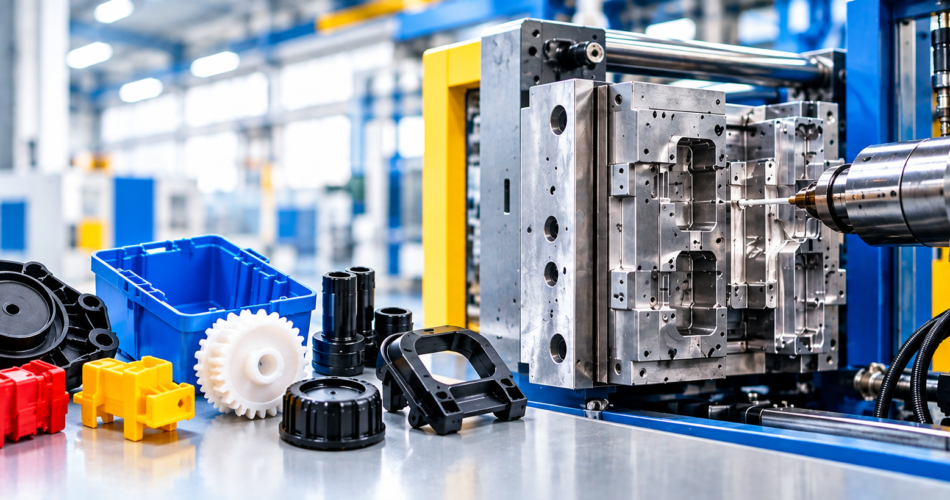
If you are sourcing plastic parts in volume, you have probably noticed that two suppliers can quote very different prices for the same drawing. The difference usually comes down to tooling, material choice and process control, not just the machine hourly rate.
At Plast Tech, we have been delivering plastic injection moulding services for 50 years to customers in automotive, electrical, medical, and industrial sectors. This guide explains how the process works, what to look for in a supplier, and the mistakes we see buyers make most often.
What Are Plastic Injection Moulding Services?
Injection moulding melts plastic granules and injects them under high pressure into a steel or aluminium mould. The plastic cools, the mould opens, and the finished part is ejected. Once the tool is made, the cycle repeats in seconds, which is why it is the standard way to produce thousands to millions of identical parts.
A full-service moulding partner usually covers:
- Part and mould design review (DFM)
- Mould (tool) making and maintenance
- Production moulding
- Secondary operations such as insert placement, overmoulding, CNC finishing and laser engraving
- Quality inspection and packing
How the Process Works, Step by Step
- Design for manufacturability (DFM). Engineers check wall thickness, draft angles, ribs, gate location and shrinkage before any steel is cut. A DFM review at this stage saves far more money than a fix after the tool is built.
- Mould making. Tools are typically made from hardened steel for long runs, or aluminium for prototypes and short runs. Tool life and cost depend on the material and the number of cavities.
- Material selection. The right polymer depends on strength, heat, chemical exposure and cost (see the next section).
- Sampling and trials. First-off samples are measured against your drawing. We adjust the process parameters until dimensions are stable.
- Production and inspection. Parts are moulded, checked at set intervals and packed.
Choosing the Right Material
|
Material |
Where it is commonly used |
|
PP, HDPE |
Caps, containers, household items |
|
ABS, PC |
Housings, enclosures, consumer products |
|
PA6 / PA66 (nylon) |
Gears, brackets, automotive parts |
|
Glass-filled nylon / PBT |
Under-hood parts, connectors, pump components |
|
POM (acetal) |
Precision moving parts, bushings |
|
PPS, PEEK |
High-temperature, chemical-resistant parts |
Glass filled polymer injection moulding deserves a special mention. Adding glass fibre increases stiffness and heat resistance, which is why it is common in automotive and electrical parts. The trade-off is that it can cause more tool wear, warpage if the design is not balanced, and a rougher surface finish. Gate and mould design matter a lot here.
Specialised Services Worth Asking About
- Insert moulding: metal inserts such as brass threads or pins are placed in the mould and the plastic is moulded around them. Useful for electrical connectors and threaded fixings.
- Overmoulding: a second material, often a softer one, is moulded over a rigid base for grip, sealing or vibration damping.
- Precision plastic moulding: tight-tolerance parts for automotive, medical-adjacent and electronic uses, where process control matters more than speed.
- Post-moulding services: CNC machining of engineering plastics, laser engraving for part numbers and logos, and assembly.
How to Choose an Injection Moulding Supplier in India
When we talk to buyers, these are the questions that separate a reliable partner from a risky one:
- Do they offer DFM feedback before quoting? Good suppliers push back on a drawing. Silence is a red flag.
- Is tooling made in-house or outsourced? In-house tooling means faster changes and clearer accountability.
- What is their machine range? Ask about tonnage, so your part is not forced onto the wrong machine.
- Which quality standards do they follow? Ask for certificates such as ISO 9001 [or IATF 16949, if true] and request sample inspection reports.
- Can they show relevant work? Ask for case studies in your industry.
- How do they handle tool maintenance and storage? Your tool is your asset, so ask where it lives and who maintains it.
What Affects the Cost of Injection Moulding?
- Tooling: the biggest upfront cost. It depends on part size, complexity, number of cavities and steel grade.
- Material: engineering and filled grades cost more than commodity plastics.
- Cycle time: thicker walls cool slower, which raises the per-part cost.
- Volume: higher volumes spread tooling cost across more parts.
- Secondary operations and inspection requirements.
A cheap quote with a thin tool or no DFM often turns into higher costs later through flash, warpage, rework and tool repairs.
Common Defects and How We Prevent Them
|
Defect |
Usual cause |
Prevention |
|
Sink marks |
Thick sections, low packing pressure |
Core out thick areas, adjust packing |
|
Warpage |
Uneven cooling, fibre orientation |
Balanced design, better cooling layout |
|
Flash |
Worn tool, excess pressure |
Tool maintenance, process tuning |
|
Short shots |
Poor venting, low pressure |
Improve gates and venting |
|
Weld lines |
Flow fronts meeting |
Gate relocation, higher melt temperature |
Industries We Serve
For example, automotive and under-hood components, electrical connector housings, pump components, and packaging items such as bottle caps.
FAQs
What is the minimum order quantity for injection moulding?
It depends on the tool. Because tooling is a fixed cost, injection moulding makes most economic sense from a few thousand parts upward.
How long does it take to make a mould?
Simple moulds can take around 4 to 6 weeks, and complex multi-cavity tools can take longer.
Can you work from a sample if I don’t have a drawing?
Yes
Get a Quote
Send us your drawing or sample, along with the material, estimated annual volume and any tolerance requirements. We will review it and come back with DFM feedback and a quotation. [Contact button or form link]
No Comments